
Your needs, this model
Does it fit your priorities?
Can a cordless portable upholstery extractor meet a documented 54-ounce clean-tank minimum?
The CL2138A-01 manual and FAQ both list a 1.6 L clean tank, about 54.1 U.S. fl oz.
Explore this need in the finder →Can I choose cordless local cleaning without requiring an app-connected model?
Essentials is the non-Wi-Fi version; the official FAQ contrasts it with the app-connected regular Spot.
Explore this need in the finder →Does the package supply a self-cleaning box for the powered brush after upholstery work?
Its manual identifies a self-cleaning box and provides the brush/box cleaning sequence.
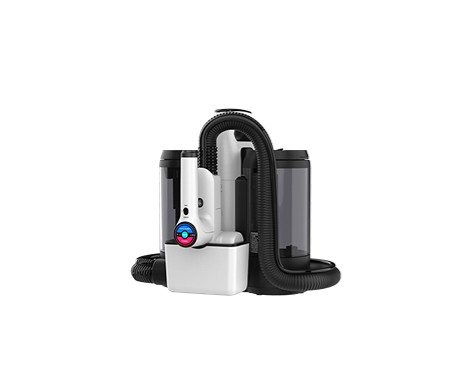
Explore this need in the finder →Tineco CARPET ONE SPOT Essentials is a cordless handheld spot extractor for localized carpet and upholstery stains. The official U.S. series listing presents it as the quieter, shorter-runtime version of CARPET ONE SPOT; its linked CL2138A-01 manual documents a smaller battery, no Wi-Fi display and a self-cleaning box. It suits small jobs where a portable powered brush is easier than dragging an upright, provided you accept the after-use tank and brush care.
Choose it for spots, not for carpet-room coverage
The tool is meant to travel to a stain on carpet, upholstery, stairs or a car interior. Its motorized power brush supports Spot, Auto and Suction submodes. In Spot mode, the sensor can stop when it detects that the mark has cleared. Auto adjusts water flow; Suction pauses spraying for a moisture-recovery pass. None of these modes turns the unit into a dry vacuum for pet hair, food crumbs or loose debris. Tineco says it is for carpet and upholstery, not hard floors, and it is not a room-size push-floor-head washer.
The support FAQ says Essentials has a 22-air-watt suction figure, while the current manufacturer comparison describes about 75 dB(A). Its manual lists a 22.2-volt, 2,500-mAh battery, 170 watts and a 15-to-25-minute running-time range; the operating section and FAQ separately cite approximately 25 minutes in Auto. Treat that as an estimate affected by mode and mess, not a promise that every cleaning session will last that long. The manual says a full charge takes about five hours, and Tineco says to use only the supplied compatible adaptor.
It gives up some battery and connectivity
The more expensive-feeling Spot name can be misleading if you assume Essentials shares every feature. Tineco's own FAQ says the regular Spot has Wi-Fi and can connect to the Tineco Life app, while Essentials does not. The regular version's manual lists a larger 4,000-mAh battery and the higher runtime claim. Essentials is simpler if app control is irrelevant and jobs usually fit within its shorter lab estimate. If app prompts or longer cordless use is essential, read the separate CARPET ONE SPOT assessment instead.
Essentials has a 1.6-liter clean-water tank and 0.8-liter recovery tank in the manual; the support FAQ agrees. That clean capacity is about 54.1 U.S. fluid ounces, enough for a 54-ounce minimum but not a 55-ounce minimum. A clean-water capacity does not predict how many stains one charge can handle: surface soil, spray mode and moisture recovery all change the routine.
Check the charging-base instructions before choosing a storage spot
Essentials includes a self-cleaning box and the manual describes fitting the power brush and box together. The charging details are less clear. The Tineco FAQ tells Essentials owners to connect the adaptor to the body, while the manual's charging instructions refer to placing it on a charging dock. The manual overview does not list a separate charging base among its parts, but other text uses “base” or “dock” when describing storage and the self-cleaning cycle. Because those directions do not agree cleanly, do not assume the delivered carton includes the same charging base as the regular Spot. Confirm the package and supplied charger instructions before setting aside a permanent charging nook.
After a wet clean, empty and rinse the dirty tank, remove and rinse the brush roller as instructed, and dry the brush parts fully. Before self-cleaning, the manual requires an empty dirty tank and more than 20 percent clean water. The support FAQ says the cycle flushes both brush and hose; it still expects you to clean the recovery tank and debris channel afterward. The washable filter also needs to dry before being returned. This is an extractor with a post-job routine, not a sealed disposable tool.
Materials set the boundary
Use the upholstery care code, not the room's appearance, to decide whether a wet extractor is appropriate. Tineco's U.S. support guidance says W or S/W is acceptable and S-only is not. Test a hidden patch for color bleed. The manual and support material advise extra caution with natural, looped or soft fibers, delicate or untagged rugs, and carpet that requires dry-only cleaning. Tineco also warns against long-pile or plush carpet, leather and technical cloth. It does not recommend this appliance for dry animal hair or large debris.
The manual calls for two bottle caps of Tineco solution in a full clean-water tank and limits the water temperature; the support page warns against hot water and says third-party detergents can cause excessive foam. If a fabric lacks a care label, seek professional advice rather than letting an attractive feature list substitute for permission to wet-clean it.
Who should choose Essentials?
Choose it for cordless, localized cleanup when the lower battery tier and lack of app support are acceptable and the compact powered brush is more convenient than a corded portable. Its documented 1.6-liter clean tank is a useful threshold advantage over a model whose manufacturer page conflicts with its manual, but it still needs a suitable surface and a complete cleanup routine.
If you need Wi-Fi, the longer runtime claim or the explicitly illustrated charging base, compare regular Spot and verify the current figures; its own product-page specification block conflicts with its manual and marketing copy. If you regularly wash entire rooms, choose an upright instead. Tineco's series page currently sends Essentials shoppers to a retailer, but does not establish stock, condition or the contents of any specific seller's box. Search using the exact CL2138A-01 model term and check the rating label and included accessories before purchase.
Key details at a glance
| Machine format | Cordless portable hose-and-powered-brush spot extractor; no upright room-cleaning floor head. |
|---|---|
| Confirmed clean-water capacity | 54.1 fl oz |
| Hose-rinse tool or port included | Yes |
| Dedicated pet tool included | No |
| Self-cleaning tray or brush box included | Yes |
| Operating routine | Select carpet or upholstery, then Spot, Auto or Suction. Spot can stop on stain sensing; Auto adjusts water flow; Suction extracts without spraying. |
| After-cleaning care | After cleaning, empty and rinse the dirty tank, clean the brush chamber/roller and opening, dry washable parts/filter as instructed, and use the supplied self-cleaning box with the specified clean-water level. |
| Battery-powered operation | Yes |
| Wi-Fi app connectivity | No |
Use the exact model’s instructions for operating limits, supplied equipment and version differences.
Sources for this assessment
- Tineco U.S. CARPET ONE SPOT family listing with current two-product cards
- Tineco U.S. CARPET ONE SPOT Essentials product-specific support and manual link
- Tineco U.S. CARPET ONE SPOT Essentials FAQs
- Tineco U.S. CL2138A-01 CARPET ONE SPOT Essentials manual
- Tineco U.S. CARPET ONE SPOT product-specific support and manual link
- Tineco U.S. CARPET ONE SPOT FAQs
- Tineco U.S. CL2138-01 CARPET ONE SPOT manual
Find a cleaner for your real workload.
Choose floor coverage or hand-tool work, then add the modes and reach you need.